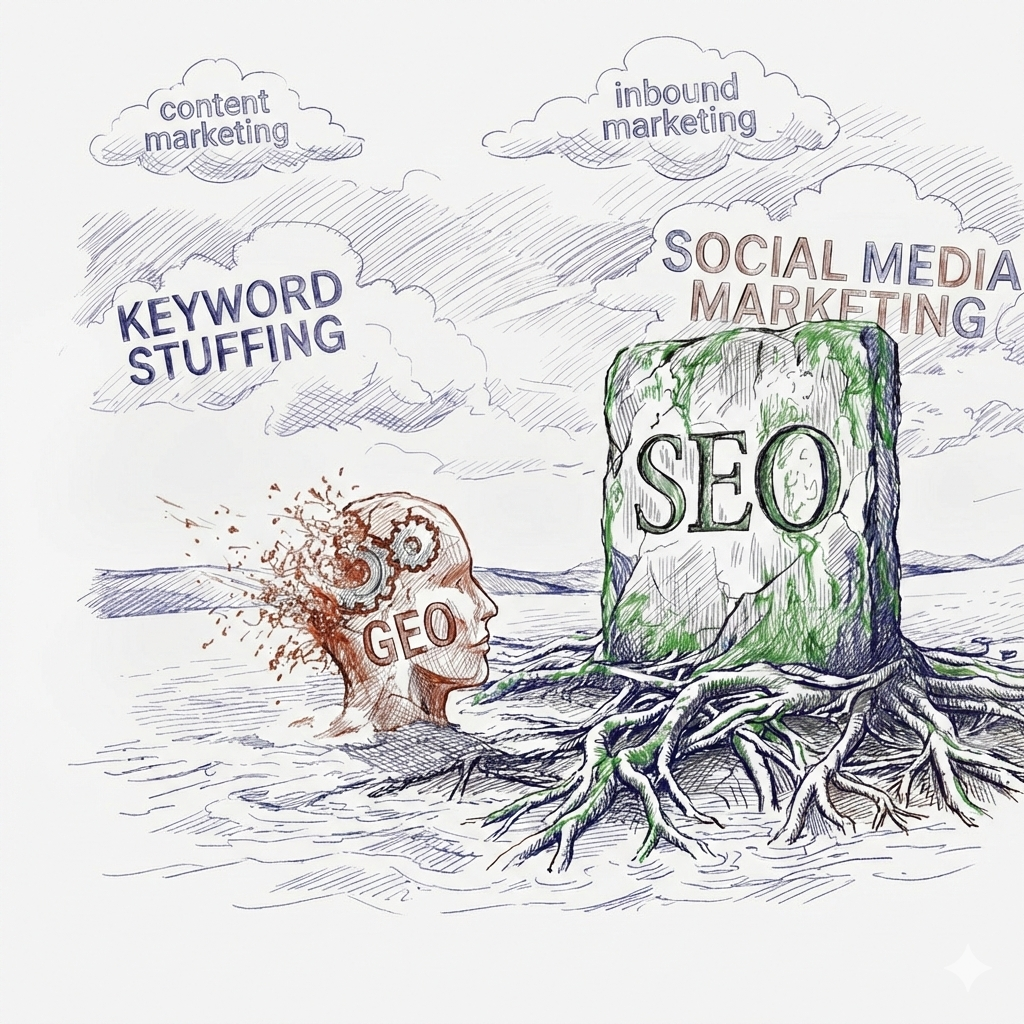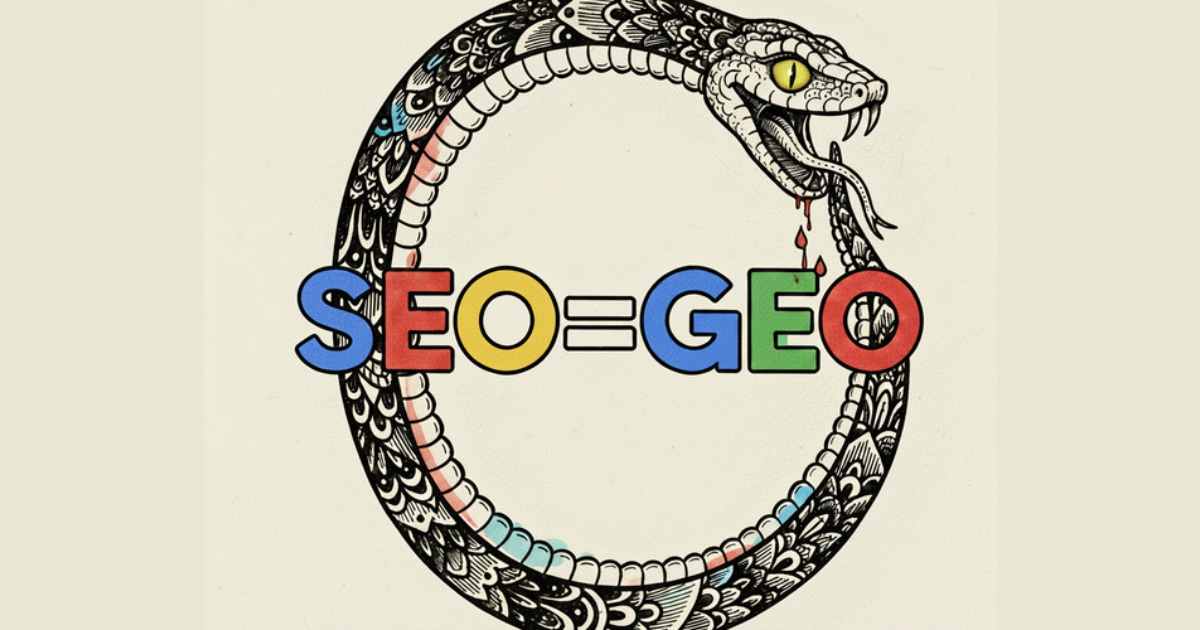
Google finally said it: “optimizing for generative AI search is optimizing for the search experience, and thus still SEO.” Their AI optimization guide, published this month. We made the same call, 3 months before them.
SEO isn’t the problem.
Google’s business model is.
SEO is portable. The click economy isn’t.
We’ve explained these three pillars to clients hundreds of times over two decades. They’re not trends. They’re foundations.
SEO is portable
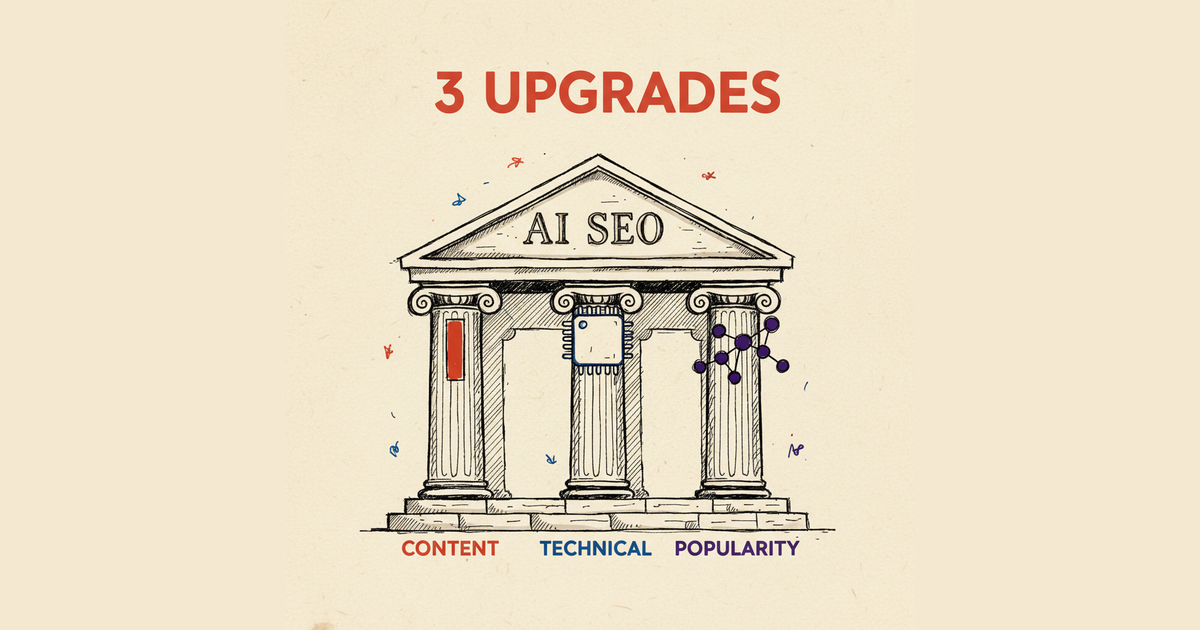
Three pillars: content, technical, popularity. We’ve broken each one down in our dedicated piece on the three pillars in the AI era. Here’s how they apply to AI search:
- Content. Still has to answer the question. AI agents now generate sub-queries to ground their answer (Google calls it query fan-out in their own guide), so you’re writing for the user’s question and the model’s decomposition of it.
- Technical. Bots still run on a budget. AI crawlers fetch per-query, not per-update, so they crawl more. Clean HTML, content in the initial server response, small payloads. Same rule, higher stakes.
- Popularity. PageRank doesn’t disappear in AI. It routes through different layers: training data is filtered by authority signals, and when an AI assistant calls a search engine as a tool (ChatGPT calls Bing, Gemini calls Google, Claude calls Brave), a traditional ranker decides what the model gets to read.
Same three pillars. Same shape across Google, ChatGPT, Perplexity, Gemini, and any agent that reads the web. Google’s own spokespeople have been saying it for years too: Danny Sullivan called it “good SEO is good GEO”; John Mueller called SEO and GEO the same job. What changed this month isn’t the position. It’s that it finally sits on developers.google.com instead of in podcast transcripts.
AI overviews fight Google’s business model
Google’s business is selling ad slots next to a clickable list of links. About 70% of Alphabet’s revenue is online advertising (per their 2025 10-K, the annual SEC filing), and Search ads alone brought in $56.6bn in a single quarter. The whole stack (AdWords on the SERP, AdSense on publisher pages, DoubleClick on display) assumes one thing: users click links, ads ride along.
| ChatGPT, Perplexity, Claude | ||
|---|---|---|
| Revenue model | Ad slots on a SERP | Subscription + chat ads |
| User click needed | Yes | No |
| AI search effect | Cannibalizes their own ad CTR | They ARE the AI search |
| Legacy stack | AdWords, AdSense, DoubleClick | None (built post-2022) |
AI Overviews break the one thing Google’s model needs: the user has to click. The Overview takes the top of the SERP. The user reads the answer there and leaves.
Google ships them anyway, because the alternative is users asking ChatGPT or Perplexity instead. And the data already says the reframe isn’t holding: news sites lost 26% of their traffic in the 12 months after AI Overviews launched, and zero-click rates on AI Overview queries now hit 80%+.
Calling AI Overviews “search experience” is Google’s attempt to keep the index and the blue links relevant. It will fail.
Bet on the source, not the click
Keep doing SEO. The discipline isn’t the problem. What needs to change is what you measure:
- Impressions aren’t visits. A citation inside an AI answer is the new impression. Plan accordingly, measure accordingly.
- Optimize for the question behind the question. When the model decomposes one user prompt into sub-queries (query fan-out in Google’s own terms), you’re ranking for the decomposition, not just the headline keyword.
- Same work. Different scoreboard. Same content. Same technical. Same popularity. New way of counting wins.
Stop measuring SEO by Google referral clicks. Measure it by whether you’re the source the answer cites: on Google, ChatGPT, Perplexity, Gemini. Anywhere the answer is composed.
The publishers about to lose are the ones still betting on the click. The ones already winning are the ones agents read first.
Are you still optimizing for the click, or for being the source? Tell us on LinkedIn.