92% of AI Overview citations come from pages already ranking in the top 10 organic results. Not from some new optimization technique. Not from a proprietary “answer engine” strategy. From regular SEO.
That single number tells you where this is heading. GEO and AEO, the two acronyms the SEO industry is currently obsessing over, will be absorbed back into SEO and forgotten. Just like every rebrand before them. The techniques they describe aren’t wrong. But the idea that they represent something separate from SEO? That won’t survive contact with reality.
What AEO and GEO actually mean
AEO is the practice of optimizing content to appear as the direct answer in AI-powered search results: Google’s AI Overviews, Perplexity responses, ChatGPT answers. The goal is to be the source the AI cites.
GEO comes from a 2023 Princeton/IIT Delhi paper that formalized optimization for “generative engines,” systems that use retrieval-augmented generation to synthesize answers from multiple sources rather than returning a list of links. The researchers found that techniques like adding citations, statistics, and clear structure could boost visibility in AI responses by up to 40%.
Sound familiar? It should. Both terms describe what SEO has been doing since Google started extracting answers directly into search results. The only thing that changed is which system consumes the answer.
AEO is 10y+ old
Here’s the timeline the AEO/GEO crowd conveniently skips:
Schema.org launches — Google, Bing, and Yahoo create a common standard for structured data. Literally formatting your content for machine extraction. Telling search engines: "Here is my answer. Take it."
Hummingbird — Google moves from keyword matching to semantic intent. SEOs start optimizing for what users mean, not what they type.
Featured Snippets — "Position zero" becomes the most coveted spot in search. Every SEO on the planet starts structuring content to be extracted as the direct answer. This is answer engine optimization. We just didn't call it that.
People Also Ask (PAA) — Optimizing for PAA becomes standard practice: anticipate follow-up questions, answer them concisely, structure with headers and lists.
BERT — Natural language understanding comes to Google's core algorithm. Content that reads naturally and answers questions directly outperforms keyword-stuffed alternatives.
AI Overviews — ChatGPT adds search. Perplexity grows. And suddenly we need new acronyms for the same work?
The progression from featured snippets to AI Overviews is a straight line. Not a revolution. An iteration. And iterations don’t need new names. They need practitioners who keep up.
SEO rebrands always die. GEO is next.
This isn’t the first time someone declared SEO dead and proposed a replacement. “Inbound marketing” was supposed to make SEO obsolete around 2012. “Content marketing” was going to replace it. SEM and SEO blurred to the point where people argued they were the same thing. Every time, the new label either faded or got absorbed. SEO survived because it describes a real, evolving practice. The rebrands described a moment.
GEO is following the same pattern. The people who’ve been in the industry long enough can see it:
- Greg Boser (SEO since 1996) put it plainly: “We don’t need to come up with a bunch of new acronyms to continue to do what we do.”
- Will Scott was more pointed: “GEO is just SEO if you’ve been doing good SEO. But the problem is so much SEO that gets done is still the same old thing.”
- Lily Ray called out agencies selling “GEO packages” as “GEO grifters.”
- CXL’s analysis concluded that AEO/GEO doesn’t differentiate itself enough to justify being anything other than a subset of SEO.
- Dawn Anderson (Manchester Metropolitan University) responded to the entire naming debate with two words: “Who cares?”
- Jonas Villwock studied 51 agencies calling themselves “GEO specialists” and found that on average, half their optimization vocabulary was standard SEO repackaged.
- Kaspar Szymanski (former Google Search Quality) put it in perspective: “Hype cycles come and go. But real SEO gains still depend on trust, crawlable data, and meeting user needs.”
- Even Microsoft, which actively promotes AEO/GEO, admits “strong SEO puts your content in front of AI platforms, since most rely heavily on existing search indexes to find sources.”
The pattern is clear. AEO and GEO aren’t wrong about what to do. They’re wrong about it being separate. The techniques they recommend (clear structure, authoritative sourcing, schema markup, topic completeness, E-E-A-T signals) have been SEO best practices for years.
Out of 33,250 job postings analyzed, only 14% use anything other than “SEO” to describe this work. The market has already voted.
So what did change?
We’re not saying nothing changed. Something did. But it’s mechanical, not conceptual:
The optimization target shifted
Before: human searches → Google ranks pages → human clicks
Now: human asks AI → AI searches → AI extracts passages → AI synthesizes answer → human may never click
You’re not optimizing for the click anymore. You’re optimizing to be the source behind the answer.
Zero-click is the default
The numbers tell the story:
- 59.7% of EU Google searches end without a click to any website
- 58.5% in the US
- Only 374 out of 1,000 EU searches reach the open web (360 in the US)
The trend is accelerating:
- EU zero-click searches rose from 23.6% to 26.1% (March 2024 to March 2025)
- Organic click rates dropped from 47.1% to 43.5%
That’s the real disruption. Not the acronyms.
Your content now has two audiences
Humans and AI systems. But making content clear enough for AI extraction is the same as making it clear enough for featured snippets. The standard didn’t change. The stakes did.
Andreessen Horowitz argues that authority shifted from backlinks to brand presence and language patterns. There’s a grain of truth here, but Google’s E-E-A-T framework (Experience, Expertise, Authority, Trust) predates the GEO conversation by years. Brand authority has been a ranking factor since long before anyone used the term “generative engine.”
What we tell our clients
Don’t rebrand your SEO program
If it’s working, you’re already doing 90% of what AEO and GEO prescribe. The 92% citation overlap with top organic results proves this. Strong SEO IS your answer engine strategy.
Do add AI visibility to your audit checklist
This is the genuinely new work: verifying that your content is accessible to AI crawlers, not just Googlebot. Most AI crawlers can’t render JavaScript. If your content depends on client-side rendering, it’s invisible to ChatGPT, Perplexity, and Claude.
We covered the technical side of this in detail in our piece on Google’s crawl limit and the GEO problem nobody is talking about.
Watch the zero-click trend, not the acronyms
The economic shift (fewer clicks reaching your site) is real and demands attention. The solution isn’t a new discipline with a new budget line. It’s adapting how you measure visibility and what you count as a win.
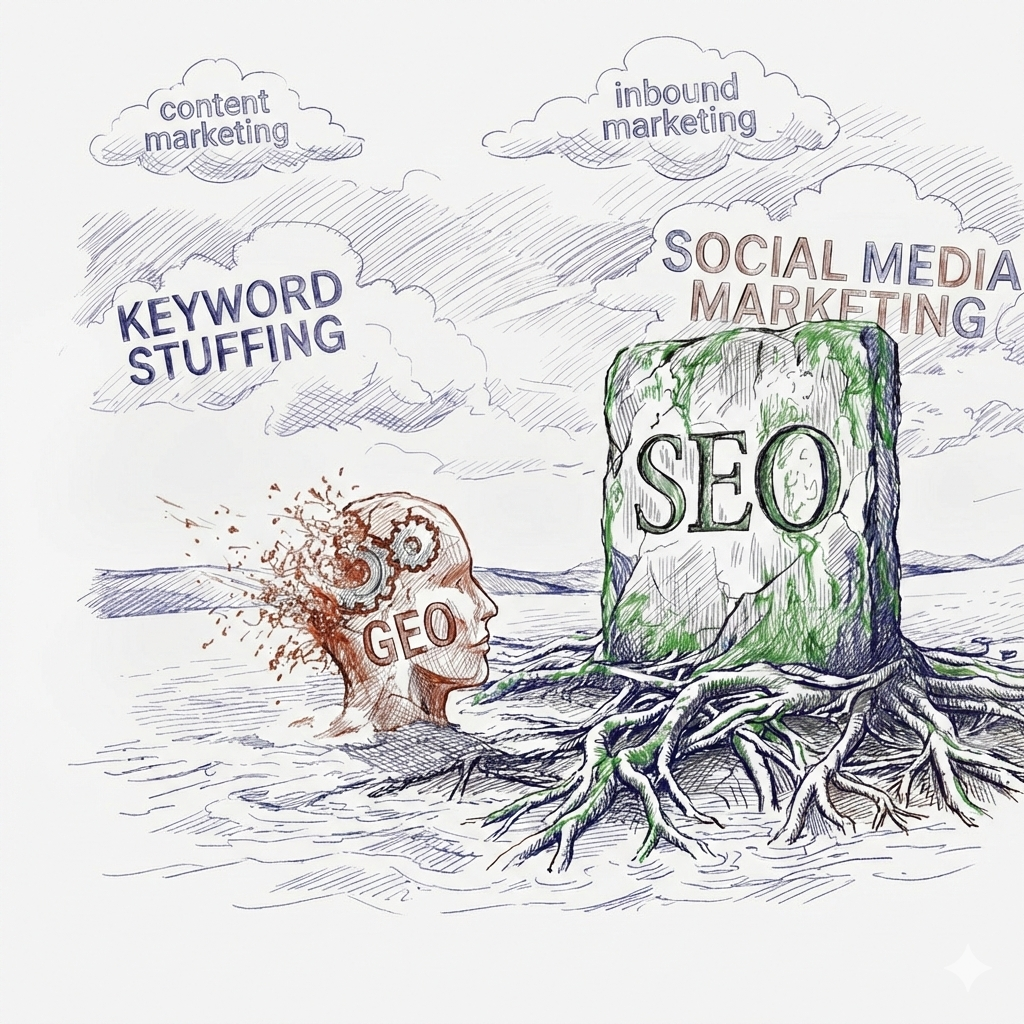
GEO will fade like every SEO rebrand before it. The useful parts, making content accessible to AI crawlers, optimizing for citation rather than clicks, will be absorbed into standard SEO practice. Within a few years, nobody will say “GEO” any more than they say “inbound marketing” today. The acronym will be forgotten. The work won’t. SEO survived keyword stuffing, survived social media, survived content marketing, survived mobile-first. It will survive AI too. Not because SEO is static, but because it’s the opposite: it evolves. That’s why GEO will die, and SEO won’t.