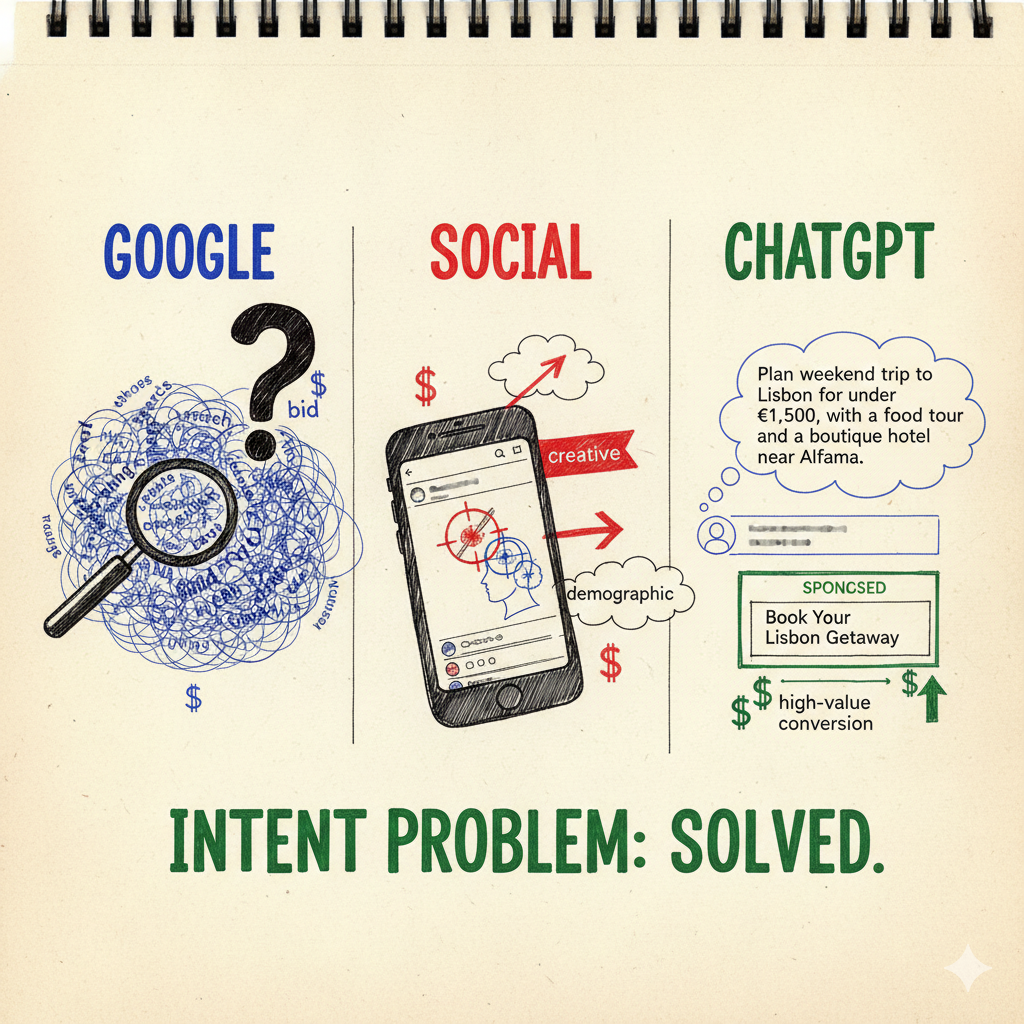
Google. You bid on a keyword and hope the user means what you think they mean.
Social. You target a demographic and hope your creative stops the scroll.
ChatGPT. The user has already said what they need, why they need it, and how much they want to spend.
That’s the intent problem, solved.
We covered what ChatGPT ads mean for users. This is the other side: why this might be the most important new advertising channel since Google Search.
How do ChatGPT ads target you?
“Plan a weekend trip to Lisbon for under €1,500, with a food tour and a boutique hotel near Alfama.”
That’s not a keyword. That’s a brief. And ChatGPT gets thousands of prompts like this every second, across 900 million weekly active users.
The ads show up as labeled “sponsored” links at the bottom of responses. Contextual, not demographic.
Ask about recipes, see a grocery delivery ad. Ask about project management tools, see a SaaS comparison. No cookies, no profile matching, no guesswork. The user already told the AI everything.
The comparison with search and social isn’t flattering for either. On Google, “running shoes” could mean browsing, researching, or buying. On ChatGPT, the user might have already specified their budget, foot problem, and preferred brand.
As Search Engine Land put it: ChatGPT catches users at the “assisted intent” stage, where they’re still shaping preferences and weighing trade-offs. That’s earlier in the decision than search, and more specific than social. Best of both worlds.
Advertising on ChatGPT is expensive? So what!
OpenAI is charging $200,000 minimum to get in. Actual pitches have ranged from $100,000 to $250,000. CPMs sit at $60.
| Channel | CPM range |
|---|---|
| Programmatic display | $2 — $5 |
| Social | $5 — $15 |
| Competitive Google Search | $30 — $50 |
| ChatGPT | $60 |
So why is anyone paying double the price of Google Search?
“I don’t think it’s an overstatement to say that AI agents will be the most lucrative advertising channel of all time.”
Aaron Goldman, CMO of Mediaocean.
The premium makes sense if the intent is real. And in a ChatGPT conversation, it is. You’re not inferring intent from a keyword. You’re reading a full conversation where the user told you their problem, their constraints, and their budget. The conversion path doesn’t get shorter than that.
The catch: measurement is clicks and impressions only, for now. No granular attribution. Advertisers used to knowing exactly which click converted are betting on the signal quality here, not the proof. That will change as the program matures, but today it’s a leap of faith.
On the guardrails side: ads don’t influence responses, sensitive topics are excluded, under-18s don’t see them, and anyone can dismiss them or turn off personalization.
Who’s buying ChatGPT ads first?
OpenAI projects $1 billion in ad revenue for 2026, scaling to $25 billion by 2029.
Travel, retail, and services go first. Obvious: those are the sectors where people ask ChatGPT commercial questions all day.
“Compare these two laptops.” “Find me a plumber in Rotterdam.” “What’s the best CRM for a 10-person agency?” These aren’t hypotheticals. They’re what 900 million users already type. When an ad shows up right after that CRM question, that’s a qualified lead. Not an impression.
B2B and SaaS will follow fast. The $200,000 minimum shuts out small players today, but the barrier will drop as the program scales.
It’s not just OpenAI
Perplexity launched ads in November 2024 with “sponsored follow-up questions” at comparable CPMs. Google is reportedly briefing advertisers on Gemini ads for 2026.
This isn’t one company experimenting. It’s a channel forming.
Three next steps for marketers
“Creative will matter more than bidding. Relevance will matter more than reach.”
That’s The Drum’s take, and Goldman agrees: “The old keyword-bid model won’t cut it.” People come to ChatGPT with a goal. Anything that doesn’t help them reach it faster is friction.
- Map your conversational intent. Not keywords. Full questions. “What’s the best CRM for a 10-person agency?” is a ChatGPT prompt, not a Google search. If you don’t know what questions lead to your product, you’re not ready for this channel.
- Check the math at $60 CPMs. Average deal value is $50? Forget it. Average deal value is $5,000? You’re in business. This channel rewards high-value conversions, not volume.
- Watch for the beta to open. Invitation-only today. First movers will have a data advantage that compounds.
“The real question for 2026 isn’t ‘how do we advertise in AI?’, but ‘why would an AI recommend us at all?’”
Lucy Robertson of Buttermilk put it best.
That’s the real shift. In a conversation, your brand authority, trustworthiness, and actual relevance to the question matter more than your bid. Sounds familiar? It should. We’ve been saying the same thing about SEO for years. Now it applies to paid, too.
Will ChatGPT ads outperform Google Search for high-intent queries? Tell us on LinkedIn.